- +32 493 43 62 95
- +34 640 866 499
- info@internationaltqi.com
Module 7: High-Risk Works and Specific Procedures
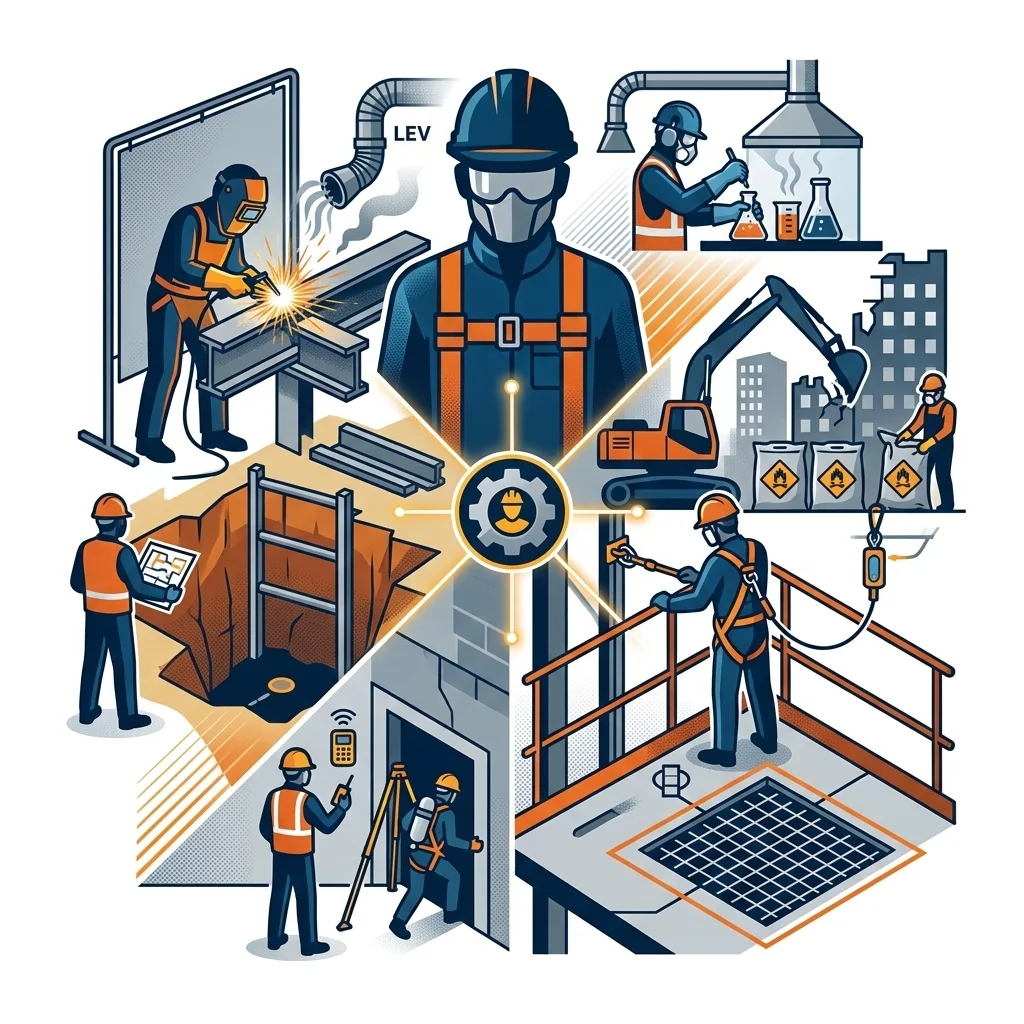
Certain industrial activities require rigorous control due to their potential to cause multiple or catastrophic accidents. In these cases, a Work Permit is always mandatory.
7.1 Hot Work (Welding and Cutting)
“Hot work” refers to any operation that generates flames, sparks, or sufficient heat to initiate combustion.
Physical Risks: UV/IR radiation (eye damage), burns, and electric shocks.
Chemical Risks: Welding fumes (suspended metal particles).
Critical Measures:
The 15-Meter Rule: Remove all flammable material within this radius or cover it with fire-retardant blankets.
Fire Watch: A person must monitor the area during the task and for 30–60 minutes after completion.
Ventilation: Use local exhaust ventilation (LEV) to capture fumes at the source.
7.2 Excavations and Underground Work
The most serious danger in an excavation is not just a cave-in, but interference with hidden utilities.
KLIC Protocol: Before breaking ground, consult maps for underground pipes and cables.
Wall Stability: For depths exceeding 1 meter, shoring (bracing) or battering (sloping) is mandatory to prevent burial.
Material Stockpiling: Excavated soil and machinery must be kept at least 1 meter away from the edge to prevent weight from collapsing the walls.
7.3 Confined Spaces
A confined space is not designed for continuous human occupancy and has limited entry/exit openings.
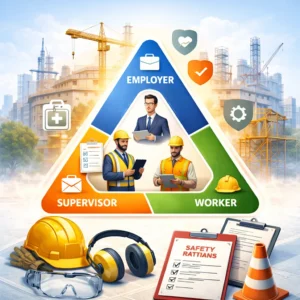
Entry Protocol (Safety Triangle):
Atmospheric Testing: Before entry, a technician must measure levels of Oxygen ($O_2$ between 19.5% and 23.5%), flammable gases (LEL), and toxic gases ($H_2S$, $CO$).
Safety Watch (Standby Person): A person stationed outside who maintains constant visual or auditory communication and never enters for rescue without proper equipment.
Rescue Plan: Availability of a rescue tripod, harness, and self-contained breathing apparatus (SCBA).
7.4 Working at Heights and Floor Openings
Any work with a risk of falling to a different level (generally from 2 meters up) requires protection.
Collective Protection (Priority): Guardrails (with handrail at 1m, intermediate rail, and toe board) and safety nets.
Individual Protection: Fall arrest harness connected to a certified anchor point.
Floor Openings: Must be covered with materials that support at least twice the intended weight, secured against accidental movement, and clearly marked.
7.5 Demolition and Hazardous Substances
Demolition is the reverse process of construction and must be structurally planned.
Demolition Order: Always from top to bottom and in the reverse order of the building’s construction.
Asbestos: If the presence of asbestos fibers is suspected, work must stop immediately. Only certified companies with decontamination equipment are permitted to handle it.
Comparative Table of Control Measures
| Specific Risk | Key Control Tool | Vital Protective Equipment |
| Welding | Protective screens / LEV | Mask with actinic filter |
| Excavation | Shoring / Sloping | S3 Safety footwear |
| Confined Space | Gas detector | Rescue harness + Tripod |
| Height | Safety guardrails | Fall arrest harness with absorber |

TQI INTERNACIONAL
VCA Training and Courses
Descubre más
Centro de Formación VCA
Cursos online
Para obtener el certificado oficial, es necesario realizar los exámenes y asistir a los cursos de forma presencial.
Contacto
Dirección:
Van Maerlantstraat, 2060. Amberes
Dias:
Monday, Wednesday, and Friday
Calendario:
16:00 - 18.30
Teléfono:
+32 493 43 62 95
+34 640 866 499
Correo: info@internationaltqi.com
©2025. internationaltqi.com | tqivca.com . Todos los derechos reservados.