
MODULE 5
Personal Protective Equipment (PPE)
Understand the role of PPE as the last line of defence and how to select, use, and maintain it correctly.
5.1 Regulations, CE Marking, and Maintenance
All professional PPE must meet strict manufacturing standards. The CE marking guarantees compliance with European safety standards.
The 3-Step Check — before every use, perform a visual inspection:
- Expiry Date: Check the manufacture/expiry date (especially for helmets and harnesses).
- Integrity: Look for cracks, tears, or excessive wear.
- Cleanliness: Ensure sensors, lenses, or filters are not obstructed.
If an item (like a helmet) suffers a significant impact, it must be replaced immediately, even if no damage is visible.
5.2 Protection Zones and Specific Standards
A. Head Protection (EN 397)
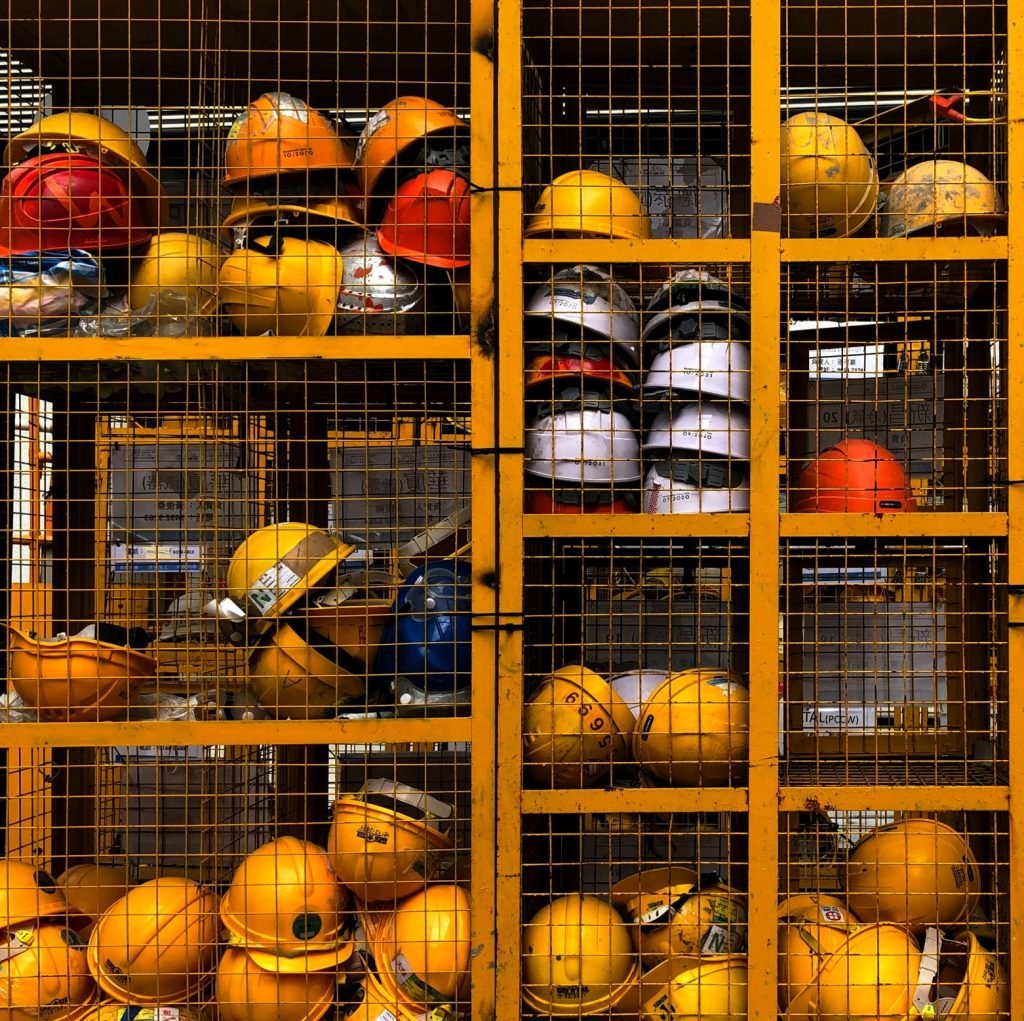
Protects against falling objects, impacts, and electrical contact. The inner suspension must be adjusted so there is a gap between the shell and the skull to absorb shock.
B. Eye and Face Protection
- Safety Glasses: For frontal impact of particles.
- Goggles (Full Seal): Essential for chemical splashes and fine dust.
- Face Shields: Used for grinding, welding, or high-risk biological exposure.
C. Hearing Protection
Hearing damage is cumulative, permanent, and irreversible.
- Earplugs: Best for continuous, long-term exposure.
- Earmuffs: Ideal for intermittent, high-intensity noise.
- Otoplastics: Custom-moulded plugs for maximum comfort and specific frequency filtering.
D. Respiratory Protection
- Particle Filters (P1, P2, P3): Against dust and mists. P3 offers the highest protection.
- Gas Filters (A, B, E, K): Colour-coded (e.g., Brown = A for organic vapours).
- If oxygen is below 19%, a filter mask is useless — an Independent Breathing Apparatus is mandatory.
5.3 Extremity Protection (Hands and Feet)
| Type | Key Features | Professional Application |
|---|---|---|
| Gloves | Resistance: mechanical, chemical, or thermal | Nitrile (chemicals), Kevlar (cut-resistant), Leather (mechanical) |
| S3 Footwear | Toecap, puncture-resistant sole, water-repellent | Standard for construction and heavy industry |
| Dielectric | Non-conductive materials to prevent grounding | Electrical work on low or high voltage |
5.4 Fall Protection (Working at Height)
In the VCA framework, specific measures start at 2 metres.
- Full Body Harness: Designed to distribute braking forces across the shoulders and thighs.
- Energy Absorber: A lanyard with a “tear-away” section that reduces the impact force on the body during a fall.
- Anchorage Points: Must be certified and capable of withstanding extreme forces (min. 12 kN).
5.5 Signage and Obligations
Blue circular signs indicate where PPE is mandatory. Workers must not enter a PPE zone without the required equipment, and supervisors must enforce compliance at all times.