- +32 493 43 62 95
- +34 640 866 499
- info@internationaltqi.com
Module 10: Fire and Explosion Prevention and Fighting
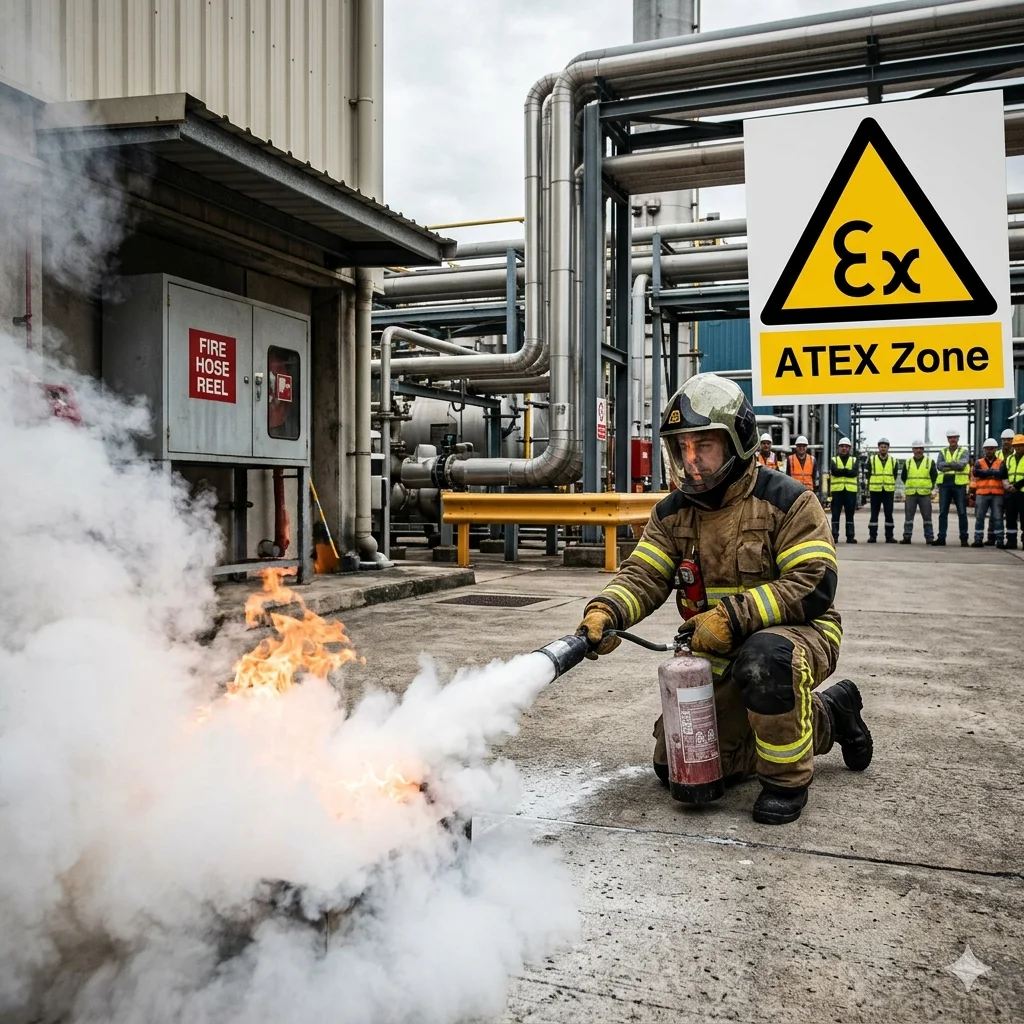
Fire and explosions represent one of the most significant catastrophic risks in the industry. Prevention is based on controlling ignition sources and the safe storage of combustible materials.
10.1 The Chemistry of Fire
For a fire to occur, three elements must be present simultaneously, known as the Fire Triangle. If one is missing, the fire is extinguished.
- Fuel: A substance capable of burning (solid, liquid, or gas).
- Oxidizing Agent (Oxygen): Generally the oxygen in the air.
- Activation Energy: The heat or ignition source (sparks, flames, electricity)
Technical Flammability Concepts:
- Flash point: The minimum temperature at which a liquid gives off enough vapors to ignite in the presence of an ignition source.
- Explosive Limits (LEL/UEL): The concentration range of a gas or vapor in the air within which an explosion is possible.
- LEL (Lower Explosive Limit): Mixture is too “lean” to burn.
- UEL (Upper Explosive Limit): Mixture is too “rich” (lacks oxygen).
10.2 Fire Classification and Extinguishing Agents
It is essential to identify the type of fuel to choose the correct extinction method.
Fire Class | Type of Fuel | Recommended Extinguishing Agent |
Class A | Organic solids (Wood, paper, cardboard, textiles). | Water spray, Foam, ABC Powder. |
Class B | Flammable liquids (Gasoline, oils, paints). | Foam, ABC Powder, $CO_2$. |
Class C | Flammable gases (Butane, propane, natural gas). | Powder (after cutting off the supply). |
Class D | Combustible metals (Magnesium, sodium, potassium). | Specific metal powder (Dry sand). |
Class F/K | Cooking oils and fats. | Specific wet chemical agents. |
10.3 Extinguishing Methods
Extinction consists of breaking the fire triangle by acting on one of its components:
- Cooling: Acts on the heat (e.g., using water).
- Smothering (Suffocation): Acts on the oxygen, displacing it or covering the fuel (e.g., using $CO_2$ or fire blankets).
- Inhibition: Acts on the chemical chain reaction (e.g., using dry chemical powder).
- Starvation (Removal): Removes the fuel (e.g., closing a gas valve).
10.4 Explosion Risk Areas (ATEX)
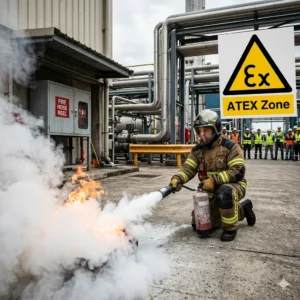
Explosive atmospheres are marked with a yellow triangle and the letters Ex. In these zones, the use of standard electronic devices (phones, cameras, power tools) is strictly prohibited as they can generate sparks.
Safety in ATEX Zones:
- Use of non-sparking tools (bronze or beryllium).
- Antistatic work clothing.
- Use of explosimeters: If the gas level reaches 10% of the LEL, the area must be evacuated immediately.
10.5 Emergency Response Protocol
In case of detecting a fire, the order of priority is:
- Alarm: Notify immediately through manual call points or the emergency telephone.
- Evacuation: Head to the assembly point following the marked routes. Do not use elevators.
- Extinction: Only attempt to put out the fire if it is small (incipient fire), the correct extinguisher is available, and there is a safe escape route behind you.
- First Aid: For burns, apply lukewarm water (not cold) for at least 15 minutes. Do not apply ointments or remove clothing stuck to the skin.
INTERNATIONAL TQI
VCA Training and Courses
DISCOVER MORE
VCA Training Center
Online Courses
To obtain the official certificate, it is necessary to take the exams and attend the courses in person.
Contact
Direction:
Van Maerlantstraat, 2060. Amberes
Days:
Monday, Wednesday, and Friday
Schedule:
16:00 – 18.30
Phone:
+32 493 43 62 95
+34 640 866 499
Mail: info@internationaltqi.com
©2025. internationaltqi.com | tqivca.com . All Rights Reserved.