- +32 493 43 62 95
- +34 640 866 499
- info@internationaltqi.com
B-VCA COURSE
Module 3. Hazard Identification and Risk Management
Professional safety management is not based on intuition but on a systematic process of identification, assessment, and control.
3.1 Fundamental Concepts
It is vital to distinguish between these two terms to perform accurate assessments:
Hazard: An intrinsic property (a characteristic) of something that has the potential to cause harm. The hazard is always present (e.g., electricity, a chemical substance, height).
Risk: The measure of uncertainty. It is calculated by analysing how likely it is that the hazard will cause harm and how severe the consequences would be.
The Risk Assessment Matrix
The matrix is the technical tool used to prioritise which risks must be addressed urgently.
| Probability / Impact | Slight (Cut/Bruise) | Moderate (Fracture/Leave) | Severe (Fatality/Disability) |
| Frequent | Medium Risk | High Risk | Critical Risk |
| Occasional | Low Risk | Medium Risk | High Risk |
| Rare | Low Risk | Low Risk | Medium Risk |
3.2 Operational Assessment Tools
There are two levels of analysis before starting any activity:
A. TRA (Task Risk Analysis)
This is a formal, documented planning process.
When: Before new, complex, or non-routine tasks.
How: The task is broken down into logical steps. For each step, hazards are identified and specific control measures are assigned.
Result: A document that serves as a guide for the entire work team.
B. LMRA (Last Minute Risk Analysis)
This is the final safety barrier before an accident occurs. It is a mandatory mental “stop and check”.
The Professional’s Mental Checklist:
Hazards: Has anything changed in the environment since the task was planned (e.g., are other workers nearby, is the floor wet)?
Resources: Do I have all the tools in good condition and the necessary PPE for this moment?
Action: Do I know what to do if something goes wrong?
Golden Rule: If you have a single doubt or a negative answer, stop the operation. Work does not start until the environment is safe.
3.3 The Hierarchy of Prevention (Order of Priority)
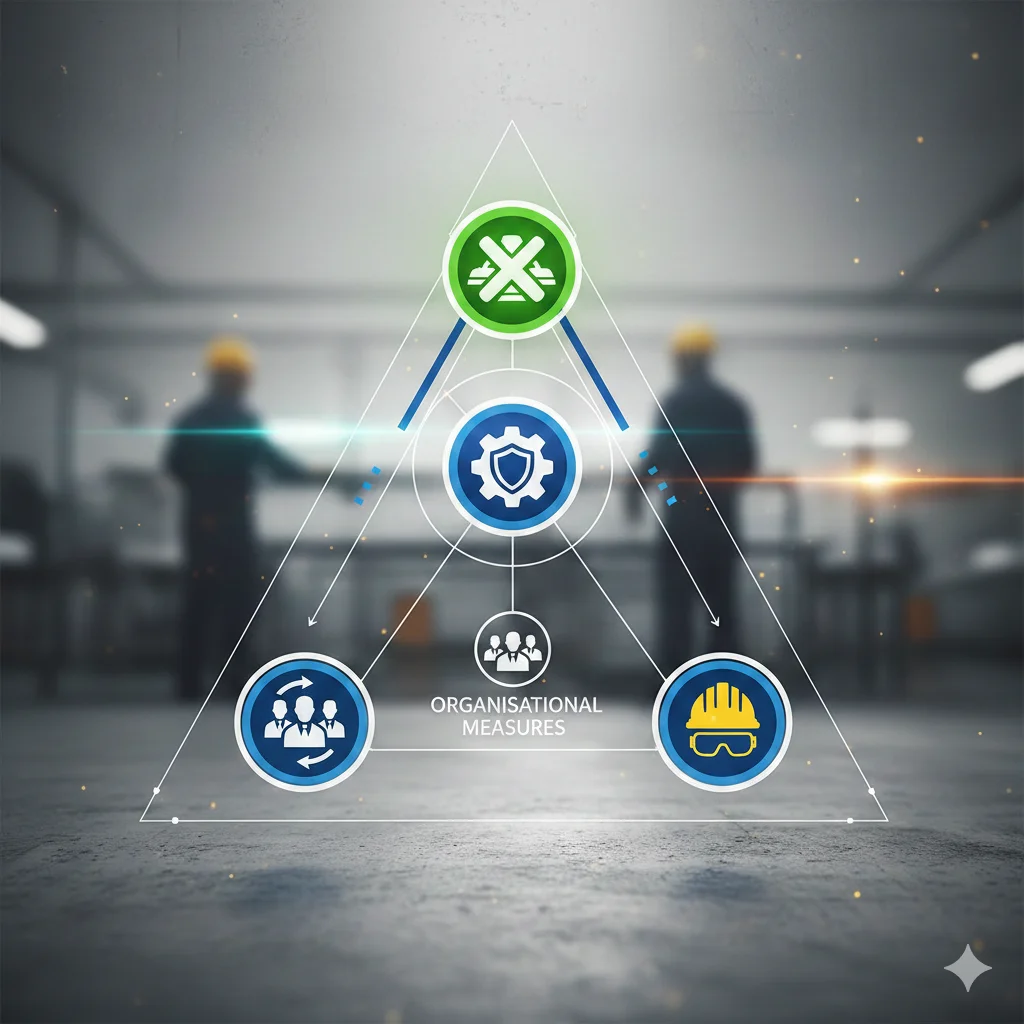
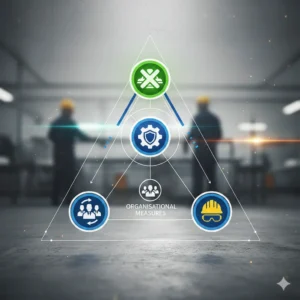
When it is determined that a risk is unacceptable, control measures must be applied following this mandatory legal hierarchy. You cannot skip to the last step without having ruled out the previous ones.
Elimination: Completely remove the hazard (e.g., do not perform work at height if it can be done with drones or from the ground).
Substitution: Replace the hazardous element with a less harmful one (e.g., using water-based paint instead of chemical solvents).
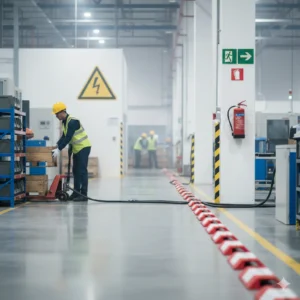
Engineering Controls: Technical solutions that isolate the hazard (e.g., machine guards, extraction ventilation, physical barriers).
Organisational Measures: Managing time and signposting (e.g., rotating shifts to reduce noise exposure, Toolbox talks).
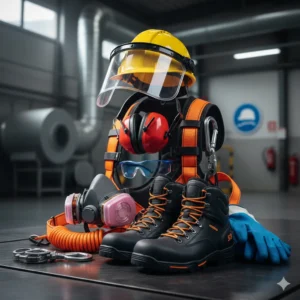
PPE (Personal Protective Equipment): This is the last resort. It only protects the individual and does not remove the hazard from the environment.
3.4 Application of Control Measures: Real Cases
| Hazard Scenario | Engineering Control (Collective Protection) | Individual Control (Last Resort) |
| Industrial noise | Acoustic enclosure of the source. | Hearing protectors (plugs or muffs). |
| Falling objects | Installation of safety nets and toe-boards. | Certified safety helmet. |
| Welding fumes | Local exhaust ventilation at the source. | Respirator with specific filters. |
| Risk of falling | Installation of sturdy guardrails. | Use of fall-arrest harness connected to an anchor point. |
INTERNATIONAL TQI
VCA Training and Courses
DISCOVER MORE
VCA Training Center
Online Courses
To obtain the official certificate, it is necessary to take the exams and attend the courses in person.
Contact
Direction:
Van Maerlantstraat, 2060. Amberes
Days:
Monday, Wednesday, and Friday
Schedule:
16:00 – 18.30
Phone:
+32 493 43 62 95
+34 640 866 499
Mail: info@internationaltqi.com
©2025. internationaltqi.com | tqivca.com . All Rights Reserved.