- +32 493 43 62 95
- +34 640 866 499
- info@internationaltqi.com

Module 6: Safety in Work Equipment and Lifting Operations
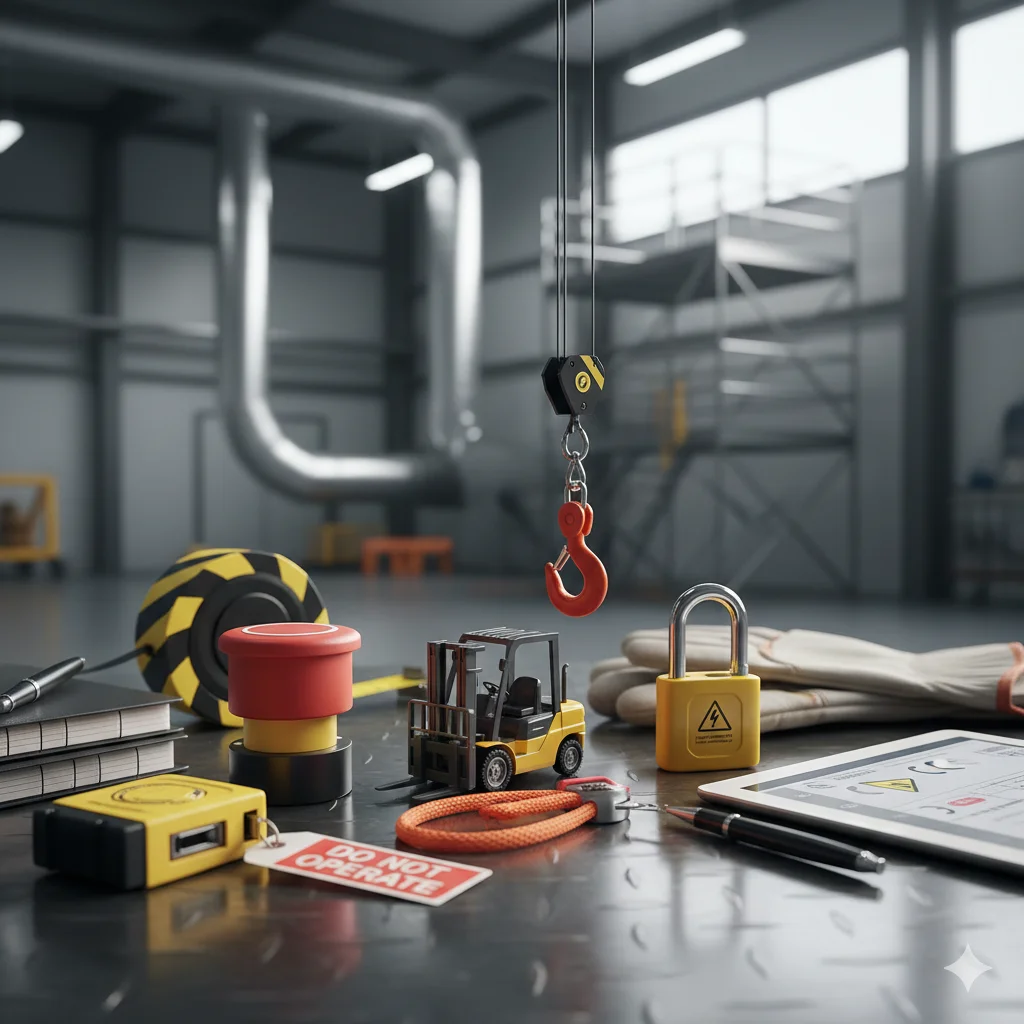
The use of tools and machinery is a primary source of severe workplace accidents. A certified professional must ensure that equipment is fit for purpose and operated within its specific limits.
6.1 Machinery Safety: Legal Requirements
In the European Union, a machine is considered “safe” only if it meets these three criteria:
- CE Marking: The manufacturer’s declaration that the equipment complies with European Safety Directives.
- Operator’s Manual: Must be present and written in a language the operator understands.
- Inspection Logs: Mandatory periodic checks (annual or semi-annual) performed by a competent person.
Critical Safety Features:
- Emergency Stop: A clearly visible “mushroom-head” button that immediately cuts power.
- Zero-Voltage Release: A safety device that prevents the machine from restarting automatically after a power cut.
- Guards and Barriers: Fixed or interlocking protections that prevent physical contact with moving parts (belts, blades, or gears).
6.2 Manual and Power Tools
A. Hand Tools (Non-powered)
The main risks are misuse and poor maintenance.
- The Golden Rule: Use the tool only for its intended purpose (e.g., never use a screwdriver as a chisel or a wrench as a hammer).
- Maintenance: Handles must be splinter-free; hammer heads must be tight; wrenches must not have “spread” jaws.
B. Portable Power Tools (Electric/Pneumatic)
- Angle Grinders: The most dangerous tool. Always ensure the RPM rating of the disc is higher than the RPM of the machine.
- Circular Saws: The retractable guard must move freely and cover the blade when not in use.
- Risk of Kickback: Always maintain a firm grip and stable stance to counter sudden torque.
6.3 Lifting Operations
Lifting requires certified accessories and a clear “exclusion zone.”
Accessory | VCA/LSC Requirement | Safety Note |
Cables & Chains | WLL (Working Load Limit) tag. | Discard if wires are broken or links are deformed. |
Fiber Slings | International Color Code. | Use “corner protectors” to prevent fraying on sharp edges. |
Hooks | Safety Latch is mandatory. | Never load the weight on the tip of the hook. |
Critical Rule: Never walk or stand under a suspended load. The lifting area must be cordoned off to prevent unauthorized access.
6.4 Industrial Vehicles: Forklifts and Stackers
Overturning and collisions are the leading causes of fatalities with forklifts.
- The Stability Triangle: A forklift is supported by three points. Raising a load shifts the center of gravity; never turn with a raised load.
- Visibility: If the load obstructs your forward view, you must drive in reverse or use a banksman (signaller).
- The Seatbelt: Mandatory at all times. In the event of a tip-over, the belt prevents the operator from being thrown out and crushed by the overhead guard (the “mousetrap” effect).
- Pallet Trucks: Pull (tow) on flat ground for better control; push only for final positioning.
6.5 Safe Maintenance Protocol (Isolations)
Before cleaning, adjusting, or repairing any machine, you must eliminate residual energy:
- Disconnect: Unplug or isolate the electrical/pneumatic source.
- Purge: Release stored pressure in hydraulic lines or air tanks.
- LOTO (Lock Out / Tag Out): Apply a physical lock and a warning tag to the isolation point to prevent accidental reactivation.

INTERNATIONAL TQI
VCA Training and Courses
DISCOVER MORE
VCA Training Center
Online Courses
To obtain the official certificate, it is necessary to take the exams and attend the courses in person.
Contact
Direction:
Van Maerlantstraat, 2060. Amberes
Days:
Monday, Wednesday, and Friday
Schedule:
16:00 – 18.30
Phone:
+32 493 43 62 95
+34 640 866 499
Mail: info@internationaltqi.com
©2025. internationaltqi.com | tqivca.com . All Rights Reserved.